
9. January 2024
The right vs wrong kind of mistake
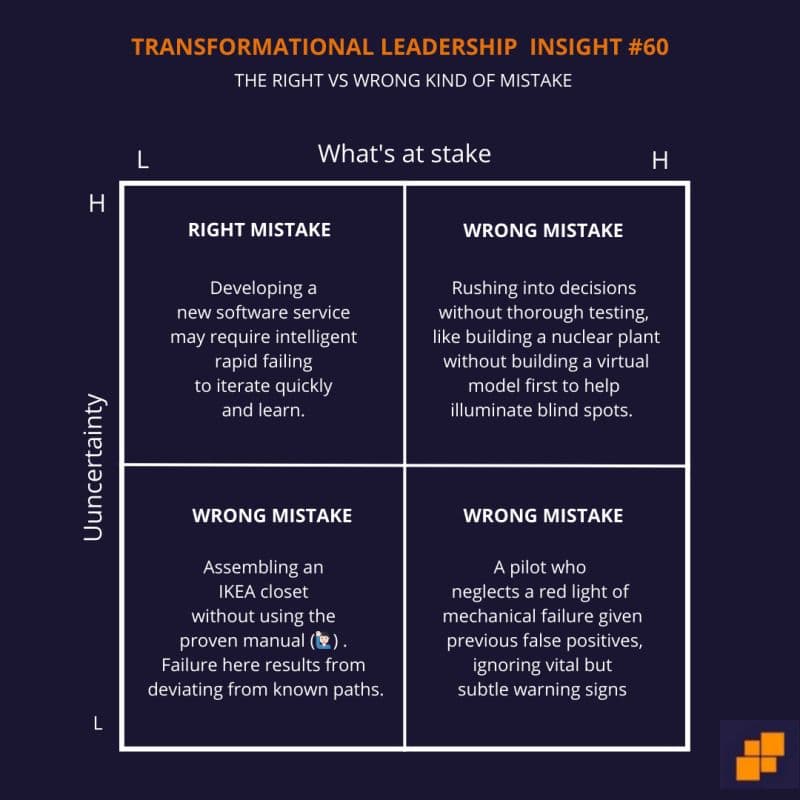
In transformative situations, failures are part of the process. But not all failures are equal. To distinguish between different types of failures, we must evaluate the severity of the consequences of potential mistakes and also consider the level of uncertainty of the context. This assessment gives us four quadrants:
- Low Stakes/Low Uncertainty Established methods for success are available. Much like assembling an IKEA closet using a proven manual (rather than attempting it haphazardly, a mistake I've admittedly made 😊), failure here often results from deviating from known paths.
- Low Stakes/High Uncertainty Embracing failure is crucial. Faced with a new context lacking established methods, we should take actions based on hypotheses and learn from the outcomes. For example, developing a new software service requires intelligent rapid testing and failure to iterate quickly and learn. However, a pervasive human fear of failure in front of peers and superiors can hinder the progress of 'good failing.'
- High Stakes/Low Uncertainty A well-checked procedural approach is vital. For example, following procedures when checking a plane before take-off ensures critical warnings are not overlooked. Engaging in experimentation or mindlessly going through routines in these high-stakes situations can lead to disastrous outcomes. Even in seemingly stable environments, staying alert during a proven process is crucial. There is a reason there is a pilot to monitor the automatic pilot...
- High Stakes/High Uncertainty This demands a cautious and calculated approach. Rushing into decisions without thorough testing, for example in failed ERP implementations or uninformed acquisitions, can result in massive failure. Controlled, careful steps and clever experimentation are imperative. Building a virtual model first or seeking diverse external perspectives can help illuminate blind spots. The danger here is that leaders hesitate to experiment in low-stakes/high-uncertainty scenarios or neglect thorough preparation and stage gates in high-stakes/high-uncertainty situations. A wise mentor once shared a valuable principle: When a mistake can sink the ship, make decisions carefully and slowly; if it only causes a problem above the waterline, go faster. Harvard Business School professor Amy Edmondson's recent book, "Right Kind of Wrong: The Science of Failing Well," provides valuable insights into understanding and navigating the nuances of failures in transformative journeys. ...meer