
11. June 2024
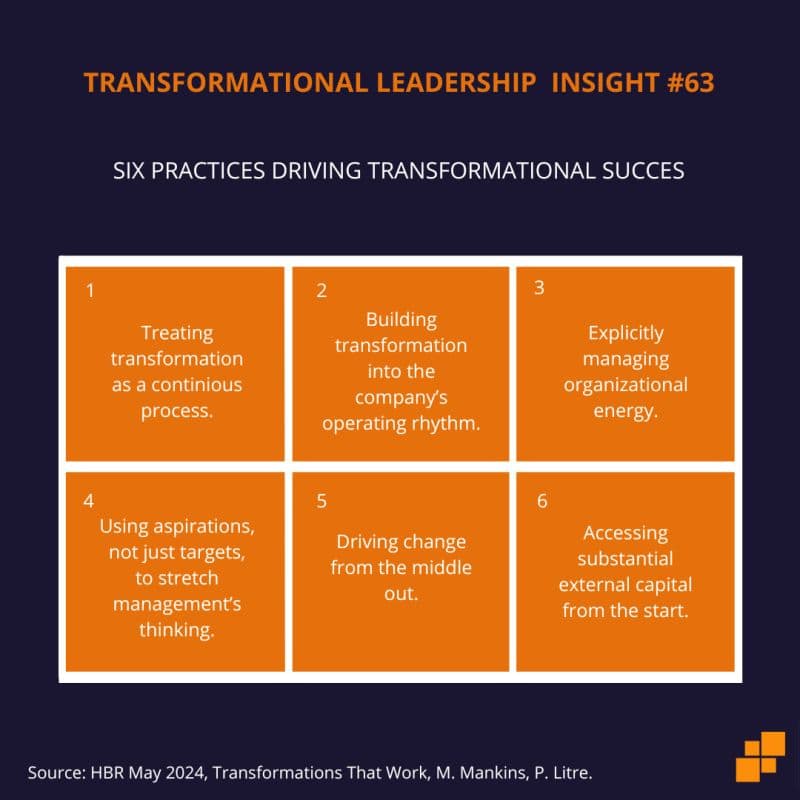
Six practices driving transformational success
Transformations That Work: Insights and Best Practices At any given time, about one-third of all large organizations are engaged in transformational programs. Yet only 12% of these programs achieve lasting results, according to this month's HBR article, "Transformations That Work," by Michael C. Mankins and Patrick Litre.
Based on their research, Mankins and Litre identified several practices that improve the odds of success. Practices that I very much like and recognize.
- Transformation as a Continuous Process Traditionally, transformational programs are treated as projects with clear beginnings and ends, following the unfreeze-change-refreeze model. However, successful transformations are more like journeys where one milestone leads to the next in a process of continuous, adaptive change. In our current, rapidly evolving environment, change is the constant.
- Building Transformation into the Company’s Operating System Effective transformations integrate change into the core business. Every manager should have both an operational and a change agenda. This requires a clear vision and understanding of how everyone can contribute. Passion and excitement about progress are infectious, “progress is happiness."
- Explicitly Managing Organizational Energy Change programs can fizzle out when they consume more energy than they generate. Celebrating milestones and energizing teams are crucial, but attempting two major changes simultaneously (e.g. use a new sales system and enter a new country at once) can lead to change fatigue. It is an art to manage (e.g. who works on what’) and sequence (‘what are the sequential steps’) changes strategically. “It's a marathon, not a sprint, and certainly not a walk in the park."
- Using Aspirations, Not Just Targets While benchmarks can be helpful, they can also limit ambition and aspirations. Setting bolder targets often requires (fundamentally) rethinking parts of the business creatively, to not just catch up to competition but leapfrog them. Ask yourself, "What if we had to achieve this bold target? What would we do if there were no limitations?"
- Driving Change from the Middle Top management setting targets while lower levels have to figure out how to achieve them is an outdated approach. Effective transformation requires cross-company intelligence and deep expertise. Appointing mid-level leaders to drive transformational initiatives and assemble cross-functional teams has proven more effective. It is also a great way to test the next generation of leaders.
- Accessing Substantial External Capital from the Start Relying on restructuring or efficiency programs to fund transformations is outdated. Many change programs are underfunded and run out of financial steam. Attracting external capital not only provides necessary resources but, in my experience, also instills greater discipline. ...meer