
22. February 2024
Making paradoxes work
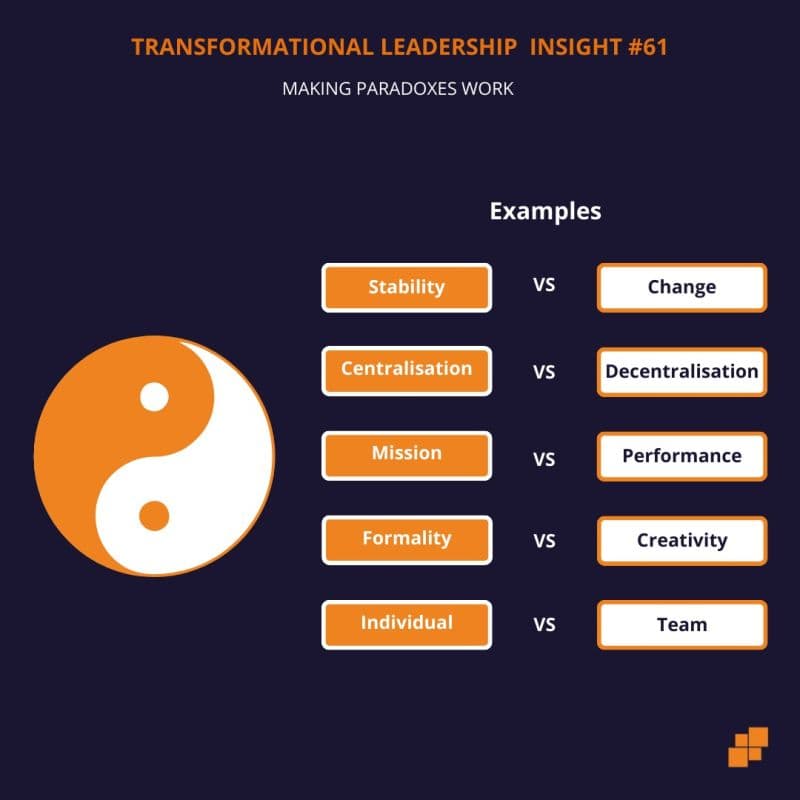
In a transformation it is critical to manage the many paradoxes in play. The notion of making clean cut choices between the surfacing dilemmas often backfires. In working through the uncomfortable tension of the dilemmas, to find creative solutions incorporating the underlying paradoxes, is where the magic lies. Examples of dilemmas:
- Stability vs Change If you focus on defending the status quo, then at some point the world has moved on, and you are forced to make a massive change to survive. However if you focus on changing everything you lose the existing strong and good parts of a business.
- Centralisation vs decentralisation Every organisation has these tensions. If you go too far to the centralisation axis, you standardise, but lose all decentral adaptation and entreperneurship. If you push too far to decentralisation you create complexity which results in tensions as well.
- Mission vs Performance If you focus on your purpose and forget your financial performance, you don’t have a future. If you focus on financial performance and forget your organisational purpose, then at some point you limit your stakeholder’s engagement.
- Formality/Bureaucracy vs spontaneity/creativity If you focus on bureaucracy and formalities, work becomes the ticking of forms, instead of finding meaningful practical solutions. If you only focus on practical solutions you create organisational chaos.
- Individual performance vs team/collective performance If you focus on individual performances, teamwork erodes. If you only focus on team/collective performances, then there is room for people to hide. High performing teams find ways to do both at the same time. In many situations, when there is a need for a transformation these dilemmas have been managed in an unbalanced way for a long time. The danger then is to swing the pendulum to the other extreme. However, only by finding the right balance can you create a more enduring change. Are you managing the paradox forces in an effective way? In this context I have found the book “Both/And Thinking” , by Wendy K. Smith and Marianne Lewis a great reminder and very helpful as they provide a lot of good insights and tools based on decades of research.