
19. October 2022
Learning to Learn Better
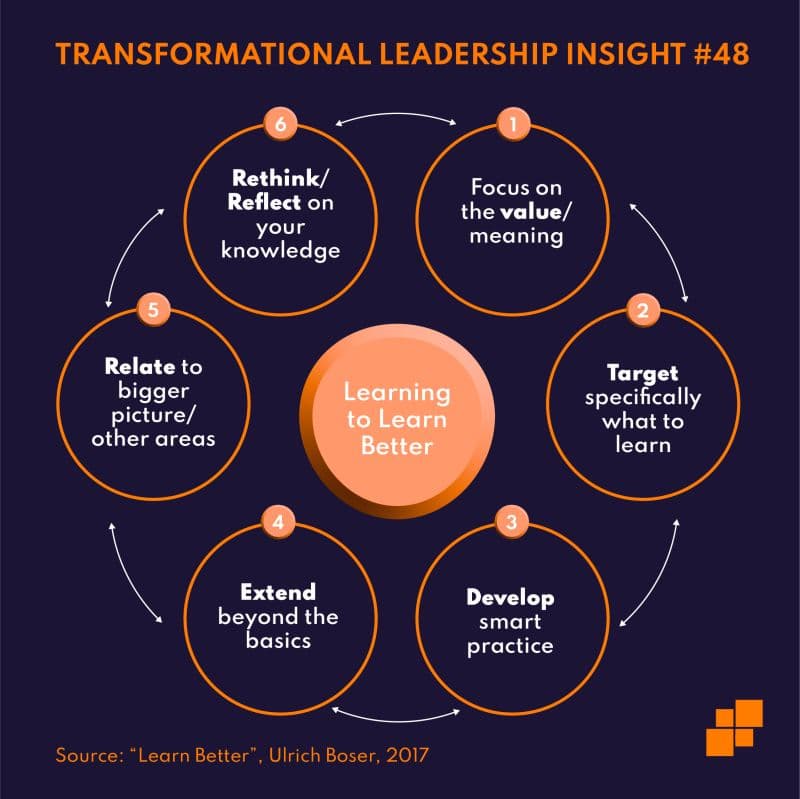
In a transformational situation, by definition you need to learn to operate differently. How well have you mastered the skill of learning itself? In this context, I really enjoyed the book “Learn Better'', by Ulrich Boser. It is full of insights and best practices. Here are some highlights:
- Value. To learn a skill/expertise, you have to see the value of it.
- So actively look for ways it’s meaningful to you. E.g. statistics students looking for ways to apply the knowledge in a sport they like.
- Also make the knowledge itself more significant. Don’t just reread and underline a text, instead learn more actively by constantly self-explaining (how does it work?), repeating it in your own words.
- Put yourself in a peer group of fellow topic learners.
- Target. It is important to set goals, select strategies, make a plan, etc. Randomly spending time on learning creates very minimal returns.
- Set the right targets of learning - challenging but doable
- Break the topic down into bitesize chunks - be aware of overload
- Ask metacognitive questions e.g,”how can I learn more effectively?”
- Use mental imagery of seeing yourself succeed
- Leverage a kitchen timer: 20 minutes studying, 5 minutes break
- Develop. You have to invest time and focus to start developing your skills. Mindless practice doesn’t create a return. Most people have driven thousands of hours but haven’t improved their driving skills.
- Focus on basic understanding and essentials first
- Repeat learnings at least 3 times, ask yourself questions about what you learned.
- Track and monitor your progress and mistakes (e.g. journal)
- Focus on achieving mastery not on reaching a level to prove yourself towards others
- Manage your resilience as making errors is part of learning (e.g. be aware of emotions like frustration, have empowering self-talk)
- Extend. Go beyond the basics and apply more of what you know.
- Look for different settings and environments to use your knowledge
- Do even more self-explaining (“How does it really work?”)
- Explain to others, give instructions
- Continue to measure and celebrate progress
- Relate. In this step, it’s key to see how it all fits together.
- Ask yourself questions about how things hang together?
- Leverage analogies of other knowledge systems
- Use the power of hypothetical thinking “if this happens, then what?’
- Write out concept maps to visualise the relationships between the parts
- Rethink. Don’t fall into the trap of becoming overconfident. Review your knowledge regularly.
- Ask yourself: ”Do I really know what I think I know?”
- Seek other settings and people with diverse views to test/enrich your knowledge
- Ask yourself things such as “How has my thinking changed?, “What do I need to learn next?” How well have you developed your learning strategy? Which of these six steps can you enhance the most?