
1. August 2023
How big things get done
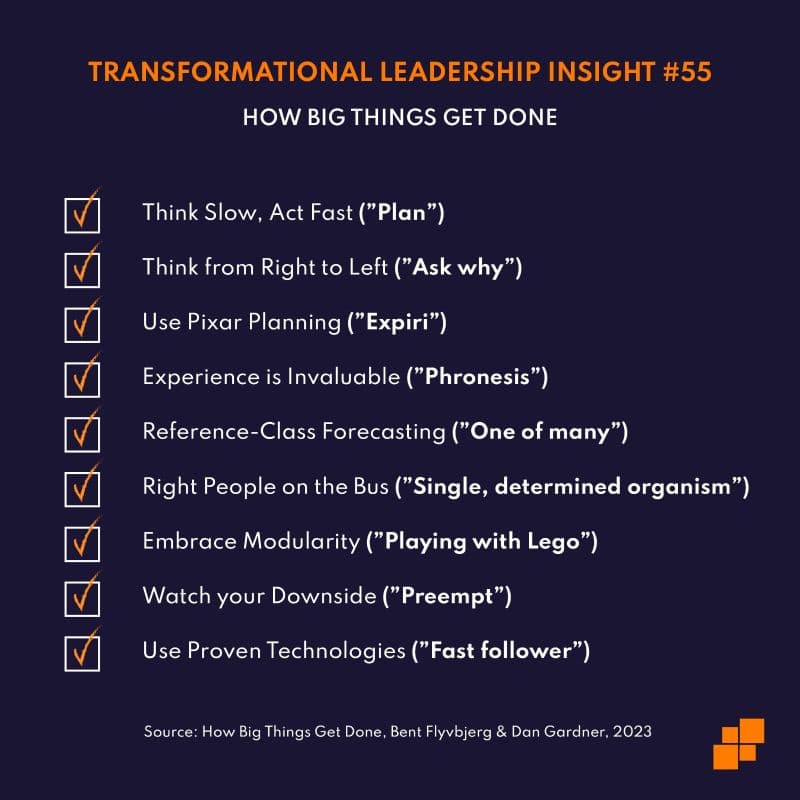
Making big projects happen is often key in a transformation. In this context I liked the new book "How Big Things Get Done" by Prof. Bent Flyvbjerg and Dan Gardner. Their extensive research on 16,000 projects provides valuable insights into project success and failure. Here are some key takeaways: Think Slow, Act Fast: Starting right and avoiding premature commitments are essential.
Projects don't go wrong; they start wrong. It's crucial to be cautious about the "Commitment fallacy" – locking in on a single path too early. Overconfidence and a bias towards action can be detrimental. As the saying goes, you want the flight attendant, not the pilot, to be an optimist. Think from Right to Left: Keeping the ultimate goal in sight is vital for project success.
Start by clearly understanding the desired state and why it matters. Then, work backwards to chart a path to achieve it. Amazon's approach to new projects, beginning with future press releases and FAQs, exemplifies this method. Pixar Planning: Embracing experimentation and learning from failures during the planning phase can be a game-changer.
The concept of "Experiri" – try, test, and learn – helps teams get on a positive learning curve. Pixar's approach to planning their movies is exemplary. They invest months in developing the initial idea, followed by a 12-page concept document, extensive reviews, storyboarding, and multiple iterations.
Experience is invaluable: Big projects often fail to leverage the full potential of experience, often due to other considerations like politics or misplaced ambition. Experience can enrich judgment and improve project planning and leadership. It's the fruit of years – "phronesis" or practical wisdom.
Reference-Class Forecasting (RCF): Many projects suffer from underestimating costs and overestimating benefits, partly due to "anchoring and adjustment" biases. A better approach is to define a smart "reference class" of projects.
This approach involves acknowledging that most projects are not as unique as they seem, and treating them as "one of those" or "one of many." The Single, Determined Organism: After thorough planning, it's time to act fast and deliver. Assembling the right people and empowering them with a shared purpose is crucial.
Just like a football team needs a consistent squad for success, a project requires a strong team identity, open communication, and psychological safety to perform at its best. Embracing Modularity: Instead of building one huge, complex thing, embracing modularity can lead to more positive learning and experimentation.
The concept of creating big things from small building blocks allows for repetition and easier management of risks. Modularity doesn't necessarily mean sacrificing quality, as seen in Apple's dazzling headquarters built from modular sections known as pods. What best practices are you applying to get big projects done? ...meer