
11. September 2026
Hope is not a strategy. Or is it?
In my experience, the right kind of hope is a fundamental mobilising energy for making change happen, especially in turbulent times. The lack of hope makes a strategy literally hopeless.
Recent research tells a more granular story about the power of hope in business transformations. In an insightful recent HBR article, Alyson Meister, Nele Dael and David Bach of IMD offer a helpful framework. They define hope not as wishful thinking but as the will to make things better combined with a credible path to get there.
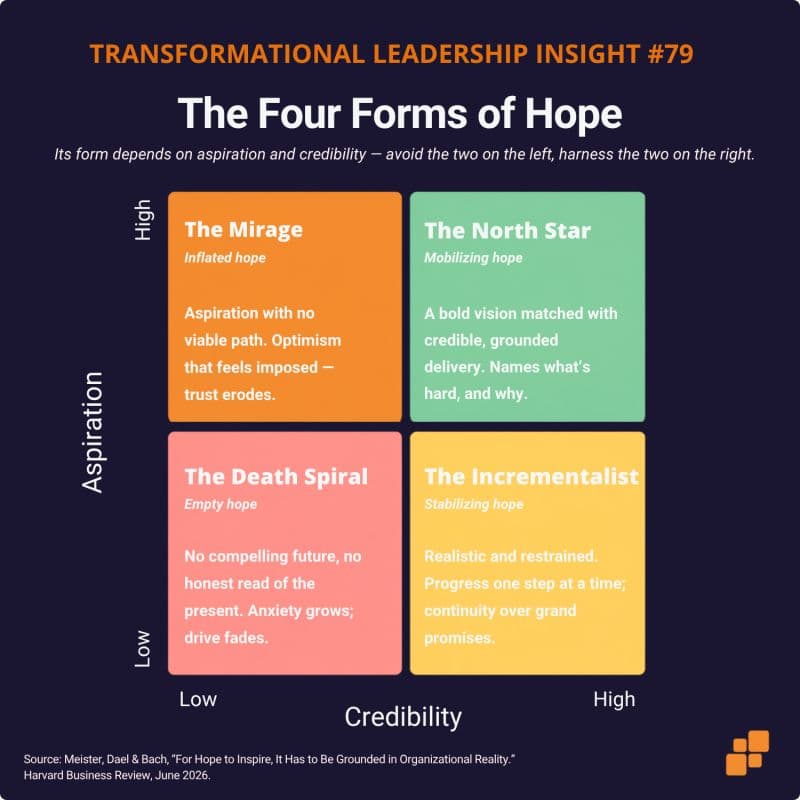
Their framework maps hope on two dimensions. How high is the aspiration? And how credible is it? Four forms emerge:
- The Mirage. High aspiration, low credibility. Inflated hope: big promises without pathways. The gap erodes trust.
- The Death Spiral. Low aspiration, low credibility. Empty hope: vague and procedural. Anxiety fills the vacuum.
- The Incrementalist. Low aspiration, high credibility. Stabilizing hope: honest about uncertainty, progress one step at a time.
- The North Star. High aspiration, high credibility. Mobilizing hope: a compelling future paired with believable pathways.
The sequence can matter. Early in a transformation, credibility is the scarce currency. Start with stabilizing hope, deliver visible proof, and earn the right to move towards the North Star quadrant. Leaders who open with a vision the organisation cannot yet believe are building a mirage, however good their intentions. But focusing only on credible paths without a vision is a recipe for stagnation.
Aspiration can be announced. Credibility must be earned.
Where would you plot your current change journey on these two axes?