
16. September 2024
Different levels of yes and no
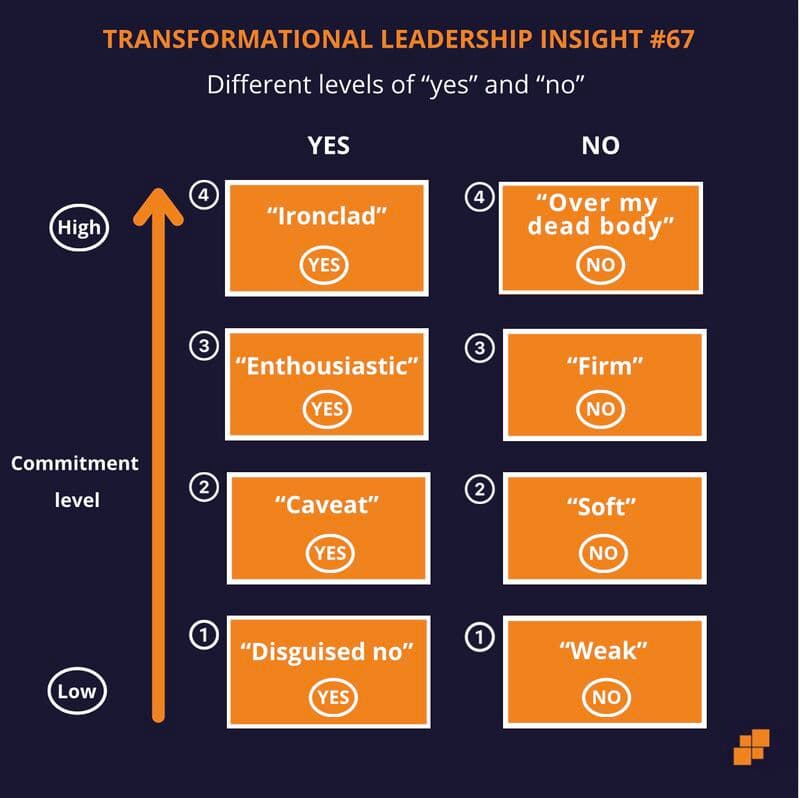
Do you know your Yeses from your Nos? In a transformational situation, it’s important to understand the true level of commitment people have behind targets, initiatives, etc. It can be helpful to assess for yourself the level of commitment behind the words “Yes” and “No.” Different levels of “Yes” commitment:
- “Disguised no” Yes This is an uncommitted “Yes.” The person doesn’t like or fears saying “No” to someone and potentially ‘hurting’ the relationship, but they are not convinced or lack the time and resources to follow through. Saying this level of “Yes” is used as a short-term stopgap.
- “Caveat” Yes This is a more committed “Yes,” but implicitly, the person giving the “Yes” assumes several conditions that need to be in place to follow through. When circumstances change or are not in place, the “Yes” flips to a “but.” It’s more like “I will try.”
- “Enthusiastic” Yes The person gives commitment and is wholeheartedly behind it, given reasonable circumstances.
- “Iron-Clad” Yes A true and deep commitment, no matter the circumstances or headwinds. Following through on commitments is part of the person’s identity and track record. Different levels of “No” commitment:
- “Weak” No This is when a person is not yet ready to give a “Yes” but wants to be a little more convinced.
- “Soft” No This is when someone, having assessed the request, in principle doesn’t want to give a commitment but might give a “Yes” if some constraints or boundaries could change. For example, if the person can drop a non-critical project, they might give a commitment.
- “Firm” No This is when someone doesn’t want to give a commitment as it really doesn’t fit or make sense and they have “their heels in the sand.” It would take a fundamental change to alter their opinion.
- “Over my dead body” No This is a hard “No” no matter the circumstances. Giving a “Yes” would be against the person’s identity and key values. How clear are your “Yeses” and “Nos” when you communicate? How clearly do you interpret the “Yeses” and “Nos” when you hear them? ...meer