
16. May 2023
Avoid your decision bias traps
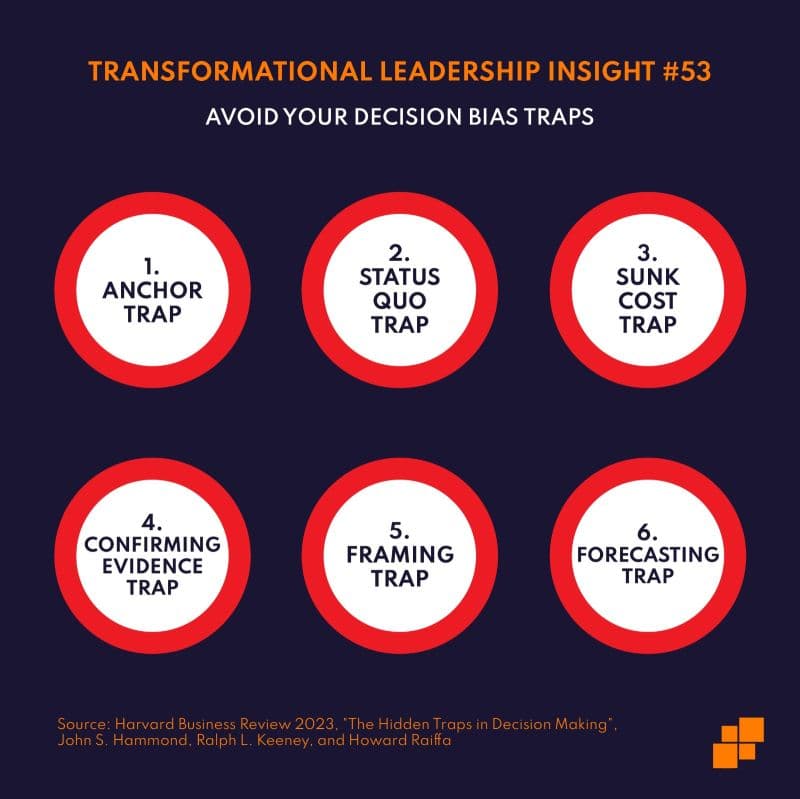
Making sound decisions are key in a transformational situation. As a good reminder I liked the Harvard Business Review article ‘The Hidden Traps in Decision Making’ by Hammond, Keeney & Raiffa. It shows that there are several psychological traps that undermine sound decision making.
- The Anchoring Trap Our minds often assign undue importance to initial impressions, estimates, or data. This can manifest in various ways. For example, in business, relying heavily on past trends as a basis for future planning, even when market circumstances have changed. To counter this trap:
- Examine the problem from different perspectives.
- Maintain an open mind.
- Seek input from a variety of people.
- The Status-Quo Trap Decision makers tend to have strong biases towards alternatives that perpetuate the status quo. Breaking from the status quo means opening oneself for criticism and regret. To counter this:
- Remind yourself of your objectives and how the status quo would serve this, are they barriers?
- Identify alternative options instead of assuming the status quo is the only choice.
- Evaluate the status quo and alternatives with the future in mind.
- The Sunk-Cost Trap This is the tendency to make choices in a way that justifies past choices. For example, pouring enormous effort into improving the performance of an employee whom you know you shouldn’t have hired, not wanting to admit to a mistake. To counter this:
- Consciously set aside sunk cost.
- Seek views from people who were not involved in the earlier decision.
- Examine why admitting to an earlier mistake distresses you. If it’s wounded self esteem, deal with it. When you are in the hole, stop digging.
- The Confirming Evidence Trap This is the tendency to seek out information that supports your point of view and avoiding information that contradicts this. What to do about it:
- Check whether you are examining all evidence
- Let someone you respect play devil's advocate
- Be honest to yourself about your motives
- The Framing Trap The first step in making a decision is to frame the question. A frame can establish the status quo or introduce an anchor. What to do:
- Don’t automatically accept the initial frame
- Try posing problems in neutral
- Ask yourself if your thinking would change when you change the frame
- The Forecasting Trap We tend to overestimate our ability to make accurate forecasts when faced with uncertainty, setting a too narrow of outcomes. What to do about it:
- Start by considering extreme outcomes and challenge your estimates.
- Examine your assumptions and assure they are not unduly influenced by your memory. Being forewarned is being forearmed against these traps. What practices do you use to avoid these traps? ...meer